














Queen isolator
 In stock
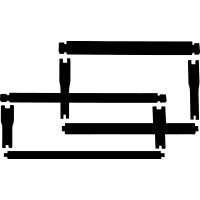
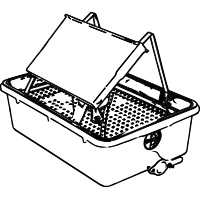
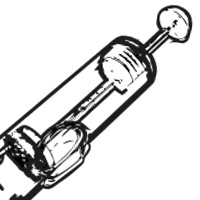
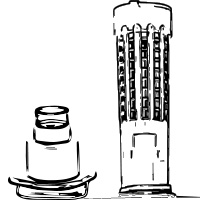
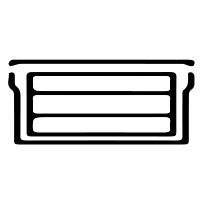
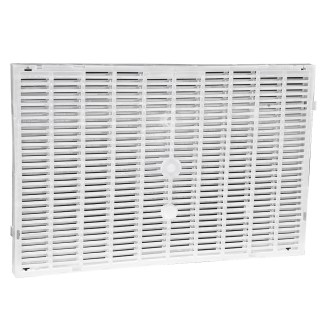
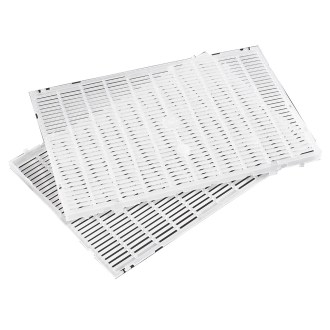
Bee isolator, made of plastic, consists of two parts in the form of queen excluders with dimensions 362 x 242 x 16 mm plus protrusions, which allows use for frames of various widths and minimum height of 24 cm, including 27.5 cm, 30 cm and 34.7 cm.

Queen isolator
The bee isolator, made of plastic, consists of two parts in the form of queen excluders with dimensions of 362 x 242 x 16 mm plus protrusions, which allows it to be used for frames of various widths and a minimum height of 24 cm, including 27.5 cm, 30 cm, and 34.7 cm. For proper placement in the frame, it is necessary to add a top bar according to the frame size. The isolator is placed in the center of the brood nest or winter cluster, depending on the chosen winter strategy and varroa treatment, usually between late September and early October. If the queen is to be isolated in it throughout the winter, it is essential to check before the first frosts that the bees have not moved outside the isolator.
Isolating the queen using honey flow isolators is the most effective method to limit her egg-laying. Although installing the isolator in the hive is somewhat more complex than placing metal or plastic excluders, beekeepers prefer to place queens in isolators.
Why use queen isolators? There are several reasons:
- restricting the queen in a nucleus - preparing space for honey stores during the most intensive feeding;
- quick queen placement;
- faster honey collection in a colony with an isolator;
- possibility to postpone spring inspections during prolonged winter and unfavorable weather;
- possibility to eliminate remaining varroa mites in spring;
- in autumn, 21 days after confining the queen, there is no more brood in the colony. This makes it possible to practically completely eliminate varroa with a one-time fumigation of the colony. Bees are thus spared repeated contact with medicinal products, e.g., amitraz.
- By preventing queens from laying during winter months, we save bees that don't need to raise the temperature in the nest to 35°C, which is required for brood care, and don't have to feed an unnecessary new generation of bees during winter.
The isolator was invented by Dr. Petr Chmara. This isolator confines the queen in a 10 mm space between two plastic excluders about the size of a brood frame. The queen thus has no contact with the comb and cannot lay eggs, while the bees can still care for her. The prototype of this method was introduced in his apiary by beekeeper Malychin, who used royal jelly. He confined the queen in an isolator similar in size to a Jenter frame. However, this method had the disadvantage that the isolator with the queen had to be moved frequently. The Chmara isolator allows the queen to move freely within the frame space.
Another advantage is in nucleus colonies where diseases such as foulbrood occur, especially when larval immunity is reduced, which is often a result of insufficient feeding due to excess brood compared to the amount of food. If the queen is stimulated to lay more eggs when stores are insufficient, it leads to inadequate feeding and cold, which can trigger brood diseases. Bees that should have a chance of successful overwintering are then overburdened with work related to raising larvae. Findings show that a bee engaged in feeding larvae during the summer season lives an average of 30 days, while bees that do not perform this work reach an age of up to 85 days. A similar situation exists with winter bees.
During winter, even during brief warm periods, egg-laying occurs. If even a small amount of brood appears in the colony, bees must increase the hive temperature from 19 to 35°C to warm and feed the brood. This need can lead to a decrease in overwintering bees that exceeds the number of newly raised young bees, and moreover, young bees may not survive until spring if winter lasts longer.
Calendar for using isolators:
In March, queens are released from isolators as bees now have access to pollen. After two weeks, approximately 6 frames of brood can be expected.
In mid-May, queens can be isolated to allow the colony to get rid of uncapped brood and prepare for the honey flow.
Between July 20-25, before the main feeding: Queens can be isolated again to allow the colony to prepare for the upcoming period.
The Chmara isolator allows overwintering of 2 or more queens in one colony. In spring, one queen is released first - the second remains isolated. Then both can be placed in separate chambers.