Digital honey refractometers
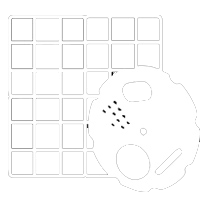
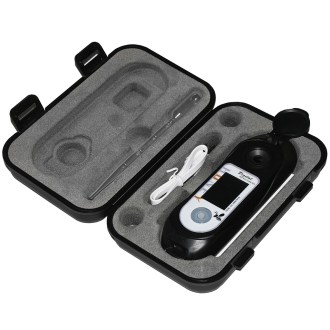
Digital honey refractometers allow you to precisely measure the sugar and water content in your honey. While traditional optical refractometers rely on the refraction of light and require both proper lighting and your eyes to read the values, a digital refractometer does all the work for you. All you need is your honey sample.
Using a digital honey refractometer is extremely simple. Just place a few drops of honey on the sampling plate and the device will automatically analyze the sample for you.
Digital honey refractometers measure the following values: Sugar Content: Measures the concentration of sugars in your honey. Density: Determines the percentage of water content in the honey.
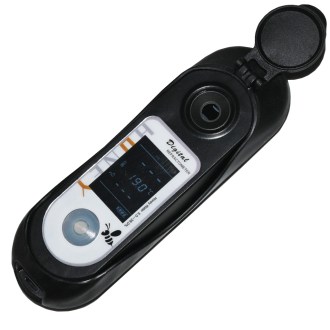
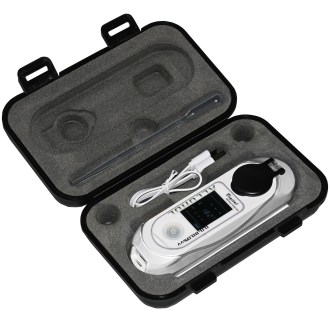
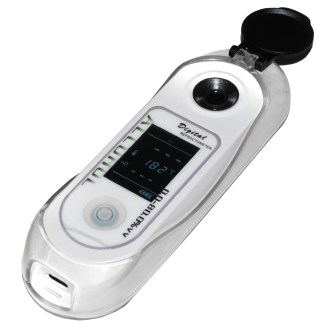
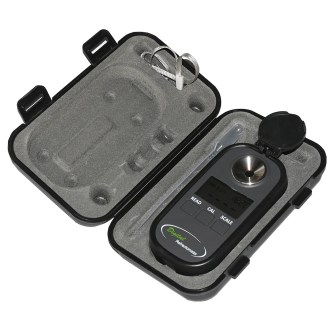
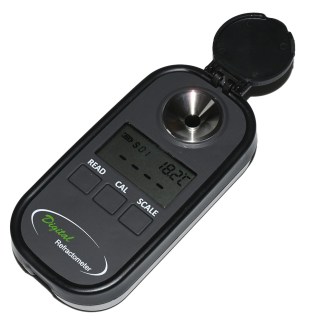
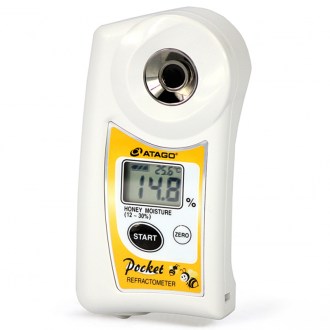
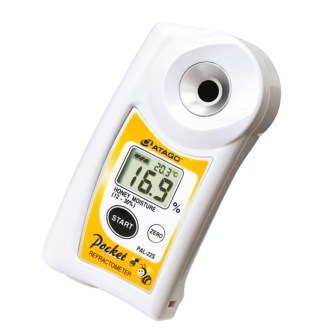
Digital Honey Refractometers
Keep the quality of your honey fully under control. Digital honey refractometers are modern and precise instruments that belong in the equipment of every beekeeper who cares about proper ripeness, stability, and long shelf life of honey. Compared to traditional optical refractometers, they offer fast, clear, and easy-to-read results, displayed clearly on a digital screen – without subjective estimation and without unnecessary reading errors.
Why controlling water content in honey is so important
Water content is one of the most critical indicators of honey quality. If the moisture level is too high, honey can begin to ferment and spoil, leading to deterioration of taste, aroma, and the entire batch. Regular measurement with a refractometer gives you confidence that you are extracting honey at the right time.
-
Legislative requirements: Water content should not exceed 20% (23% for baker’s honey).
-
High quality: Honey with moisture below 17–18% is considered very well ripened.
-
Storage stability: Accurate measurement helps determine whether honey is suitable for long-term storage or requires further drying.
What a digital honey refractometer measures
A digital refractometer works on the principle of light refraction in a drop of honey. The display shows an exact value, most commonly as water content expressed in percent. Moisture is the key parameter in honey that determines its stability and shelf life.
Many models are equipped with Automatic Temperature Compensation (ATC), which corrects the result for common temperature differences in the honey room, apiary, or during field work. For maximum accuracy, it is still recommended to measure a sample that is neither extremely cold nor overheated.
Advantages of a digital refractometer over an optical one
While optical refractometers require viewing against a light source and correctly interpreting the color boundary on a scale, digital instruments take working comfort to a higher level.
-
Instant result – an exact numerical value displayed within seconds.
-
No subjective error – no guessing, no squinting.
-
Comfort for frequent measurements – ideal during extraction and when checking multiple batches.
-
Good repeatability – easy comparison of results over time.
Measurement options and available scales
Digital refractometers often allow switching between several units as needed:
-
Water % – direct expression of water content in honey.
-
Brix (%) – sugar content, also usable for other solutions.
-
Baumé (°Be) – liquid density.
-
Refractive index (nD) – a physical value used in laboratory practice.
For everyday beekeeping, the most important feature is a reliable and clearly readable display of moisture in %.
How to choose a digital refractometer for beekeepers
When selecting an instrument, consider not only the price, but above all your beekeeping practices, extraction frequency, and accuracy requirements.
-
Measuring range: The instrument should be designed specifically for honey (typically a moisture range of 10–30% or Brix approx. 58–90%).
-
Accuracy: For practical use, a maximum deviation of ±0.2% water content is recommended.
-
ATC: Automatic temperature compensation significantly increases confidence in the result.
-
Durability and maintenance: A waterproof design (e.g. IP65) makes cleaning and work in the honey room easier.
-
Calibration: A simple calibration procedure and availability of calibration solution are major advantages.
How to correctly measure honey with a digital refractometer
-
Check calibration – ideally before the season and regularly during extraction.
-
Prepare the sample – stir the honey so it is homogeneous and free of air bubbles.
-
Apply a small amount of honey to the measuring surface or prism of the device.
-
Start the measurement – the result will appear within a few seconds.
-
Thoroughly clean the device – this prevents distortion of subsequent measurements.
Practical tip: Measure multiple samples from different combs or containers. Moisture can vary between the upper and lower parts of the honey as well as between individual frames.
Using a digital refractometer throughout the season
A digital refractometer is useful at several key moments of the beekeeping year:
-
Before extraction – checking the ripeness of partially capped combs.
-
During extraction – comparing individual batches and apiary locations.
-
When blending honeys – harmonizing parameters of mixtures.
-
Before bottling – final quality control.
-
During storage – verifying suspicious changes in honey.
Choose a refractometer that matches your beekeeping
Digital honey refractometers give you confidence that your honey meets high standards of quality, stability, and storability. Whether you keep bees for your own needs or sell honey directly from the farm, a properly chosen instrument will repay you with peace of mind, satisfied customers, and a trouble-free season.